Mice Born in Space: A Breakthrough in Understanding Reproductive Health
December 30, 2025247 VuesTemps de lecture: 2 minutes
Taille de police
16
In a significant scientific breakthrough, the Chinese Academy of Sciences' Space Technology and Engineering Center has reported the successful outcome of a unique space experiment. A female mouse gave birth to healthy offspring after returning from a mission aboard the Chinese space station.
Details of the Space Mission
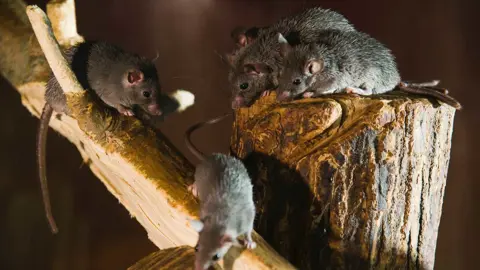
Four mice were sent into space on October 31 aboard the Shenzhou-21 spacecraft, where they lived in a specially designed environment on the space station. The mice returned to Earth on November 14, and one female gave birth to nine pups on December 10, six of which survived and displayed clear signs of health and normal activity.
Healthy Offspring and Natural Care
Researchers confirmed that the mother cared for her pups naturally after birth, and the young mice exhibited evident vitality, which is seen as a positive indicator of their health and development following exposure to the space environment.
Scientists: Space Did Not Impact Fertility
Wang Hongmei, a researcher at the Chinese Academy of Sciences' Zoology Institute, stated that the experiment's results demonstrated that short-term space travel does not negatively affect the reproductive capabilities of mice. She noted that the data collected during the mission holds significant scientific value for understanding the impact of space on early mammalian development.
Unexpected Challenges in Orbit
The mission faced unforeseen difficulties due to a schedule adjustment for the return of the Shenzhou-20 mission, resulting in a temporary food shortage. The scientific team managed the crisis by providing water and using soy milk as a temporary food alternative until the situation was fully stabilized.
AI Monitoring Life in Space
Researchers employed an advanced AI-supported monitoring system to track the mice's behavior, sleep patterns, and feeding habits in real-time. This technology enabled the scientific teams to make quick and informed decisions throughout the mission.
A Groundbreaking Experiment in China
The Chinese University of Sciences confirmed that this mission represents the first comprehensive space experiment involving mammals in the history of China's space program, covering all phases from pre-launch preparation to in-orbit experimentation and post-mission analysis.
A Step Towards Expanded Space Research
Scientists noted that this achievement paves the way for more extensive space experiments on mammals, focusing on monitoring the development of the pups after birth and studying their reproductive capabilities in the future. Researchers believe these studies could reveal, for the first time, the effects of space travel across generations, which is crucial for the future of long-term space missions and potential colonization efforts.