Rare Polar Bear Adoption Observed in Canada
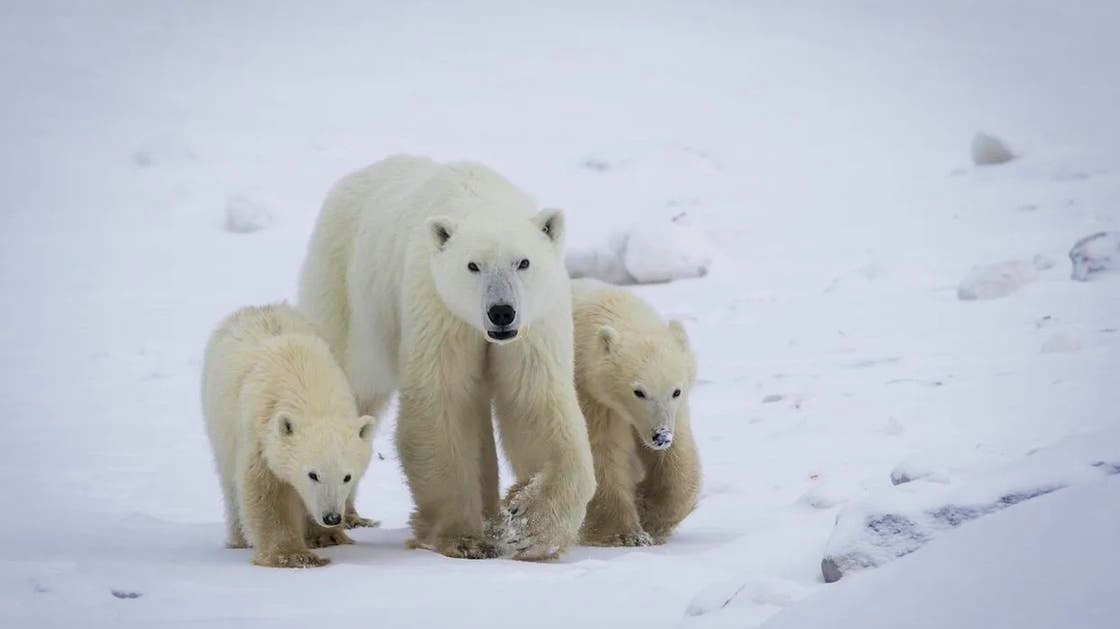
In a unique occurrence, researchers in Canada have recently observed a polar bear adopting a cub that she did not give birth to, marking one of the 13 documented cases in 45 years.
Ivan Richardson, a researcher with the Canadian Wildlife Agency who has studied polar bears for 25 years, informed Agence France-Presse: "Only 13 cases of this nature have been recorded in 45 years."
The incident took place last November near the town of Churchill, located north of Manitoba, known as the "polar bear capital of the world."
The research team observed a female bear with two cubs, one 10 months old and the other 11 months old.
They noted that one cub bore an identification tag, while the other did not, and the female had been seen months earlier with only one cub.
In this northern region, researchers use identification tags to track polar bears throughout their lives, allowing the team to monitor the cubs using GPS collars, in collaboration with Polar Bears International, an organization dedicated to polar bear research.
Richardson described the behavior of the female bear as "remarkable," as she kept both cubs with her for several weeks. He emphasized that polar bears possess a strong maternal instinct that enables them to care for young that are not biologically theirs.
This event occurs against the backdrop of a declining polar bear population in the western Hudson Bay area, which has decreased by 30% over recent decades, from approximately 1,200 bears in the 1980s to around 800 today, largely due to rapid ice melt, a critical factor for their survival.
Despite these environmental challenges, there is currently no evidence linking this adoption behavior to climate change.
Researchers are conducting genetic analysis to determine the biological mother of the adopted cub, with a high likelihood of identifying its lineage.
Over the past 45 years, more than 4,600 polar bears have been observed in the region, making it, according to Richardson, "the best-studied polar bear population in the world."